Reduce LLM Spend with Semantic Routing
Use agentgateway, vLLM Semantic Router, and catalog-priced telemetry to reduce routine coding-model spend without routing every request to the cheapest model.
I spend a lot of time in Go and Rust, where a quick “one more thing” in a long coding chat can turn a tidy refactor into an hour of debugging. After the hard part is over, routine tests and follow-up questions can still burn premium-model credits. Sending every request to a cheaper model is not the answer: distributed-systems design, correctness work, and difficult debugging need more capable help.
This example combines vLLM Semantic Router (vSR)
with agentgateway to send routine Go and Rust
coding tasks to gpt-5.4-nano and escalate complex correctness,
distributed-systems, and deep-debugging work to gpt-5.5. The goal is a
reproducible cost reduction without quietly routing everything to the cheapest
tier.
Make the Decision Observable
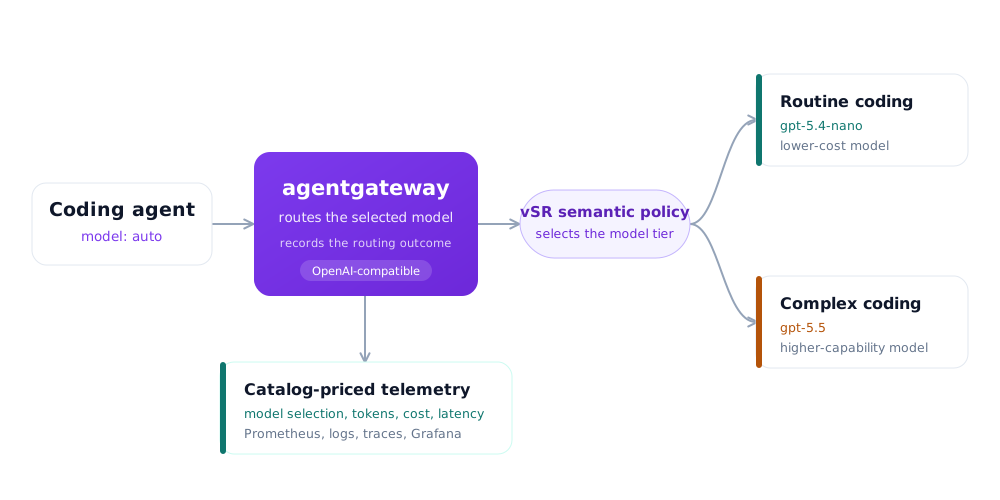
The client sends an OpenAI-compatible request with model: "auto". An
agentgateway policy sends it to vSR, which evaluates semantic, complexity,
keyword, context, and structure signals before selecting a model. Agentgateway
forwards the request and records the outcome. Cost is not a classifier input;
it is measured after the request, keeping the policy explainable.
auto opts into that automatic selection. A client can instead request
gpt-5.4-nano or gpt-5.5 directly to force a tier and bypass automatic
routing; the request still passes through agentgateway. Organizations
that require automatic routing can use a request-body
transformation
to rewrite every request to auto.
Price the Outcome at the Gateway
My company needs prices, not just token counts, to make a budget decision.
Agentgateway loads a model cost catalog and exposes realized request cost in
metrics, logs, and traces. The model cost catalog
guide explains how
to generate and load the catalog with agctl.
For this evaluation, I use the integrated OpenTelemetry stack. Prometheus, Loki, Tempo, the OpenTelemetry Collector, and Grafana let engineering and finance inspect the same model-selection event.
A Small, Reproducible Evaluation
I built the cost-based semantic routing demo around a compact 50-prompt Go and Rust dataset. Half of the prompts are routine implementation or test work; the other half involve correctness or distributed-systems problems. I send every prompt through two lanes:
| Lane | Purpose |
|---|---|
routed | vSR selects gpt-5.4-nano or gpt-5.5. |
always_expensive | Every request uses gpt-5.5; the cost baseline. |
Each run has an ID on every request, so its cost query excludes unrelated cluster traffic. I deliberately leave out a forced-cheap lane: the useful comparison is whether routing saves money while still escalating complex work.
Each prompt has an expected tier in the checked-in dataset: 25 routine prompts
expect gpt-5.4-nano, and 25 complex prompts expect gpt-5.5. Expected-tier
agreement is the share of requests where vSR selected that labelled tier. It
checks the routing policy, not the quality of the model’s answer.
In a clean run on July 16, 2026, all 100 primary requests completed with exact
model-catalog lookups. vSR selected gpt-5.4-nano for 30 requests and
gpt-5.5 for 20. Catalog-priced agentgateway metrics reported $0.591444 for
the routed lane versus $0.914840 for the always-expensive lane, a 35.4%
cost reduction. Routed p50 latency was 5.22 seconds, compared with
7.55 seconds for the always-expensive lane. P95 was 19.09 seconds for
routed traffic and 19.61 seconds for the always-expensive lane.
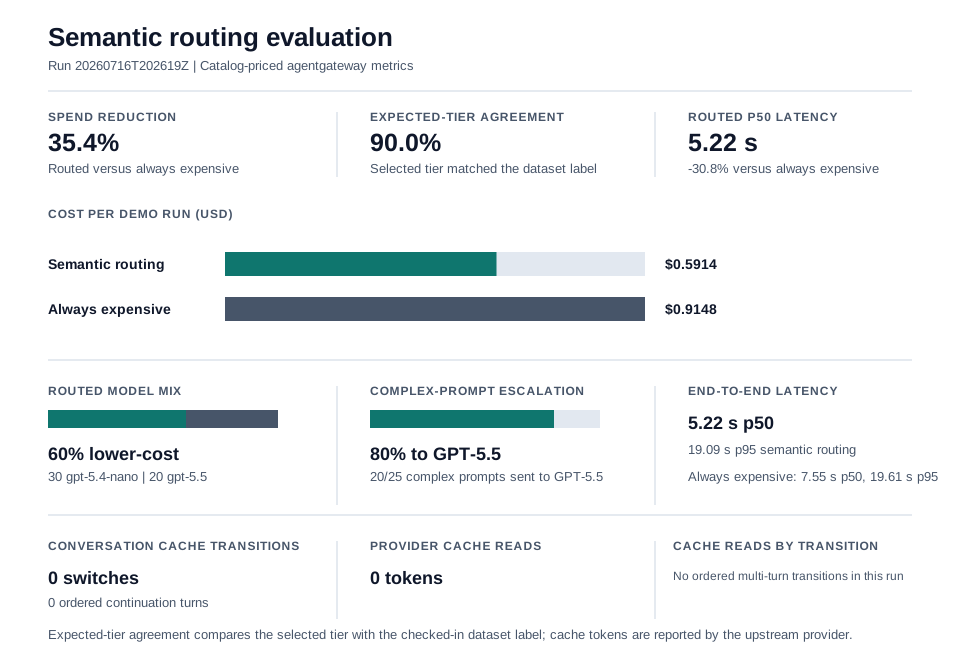
The chart reached 90% expected-tier agreement (45 of 50 prompts). All 25 routine prompts stayed on nano, and 20 of 25 complex prompts escalated to GPT-5.5. This is not a claim of perfect model selection, but it shows the savings did not come from a blanket downgrade: 40% of routed requests still used the expensive model. It is a policy sanity check, not an answer-quality benchmark or a substitute for application task-success and user-feedback data.
The default dataset uses independent requests. For long-running coding agents, the optional cache-transition evaluation uses two ordered ten-turn Go and Rust conversations with a stable prefix. It reports provider-observed cache reads by model transition without mixing cache behavior into the primary evaluation.
Try It
The demo automates the setup work I would otherwise repeat by hand. It uses the agentgateway semantic-routing example, creates or reuses a kind cluster, and installs agentgateway, vSR, a model cost catalog, and the OpenTelemetry stack. It checks readiness, routing, catalog-priced metrics, logs, and traces before the primary requests run.
Before running it, review the demo requirements: 12 GiB of Docker memory, 30 GiB of free disk, the required CLIs, an OpenAI API key, and access to both models.
git clone https://github.com/danehans/agentgateway-demos.git
cd agentgateway-demos/cost-based-semantic-routing

export OPENAI_API_KEY='sk-...'
./demo.sh all --yes
The default run sends 106 billable requests: two routing probes, four smoke-test
requests, and 100 primary requests. It writes request-level JSONL, an
evaluation-scoped Prometheus report, and an SVG chart under results/.
When I want to change the policy, I edit the fetched vSR values, redeploy with
./demo.sh router, and run ./demo.sh eval --yes again.
Use It From Codex
Codex lets me choose a model manually, but a user-level profile can instead
send every request to a gateway such as agentgateway with the stable auto
model name:
# ~/.codex/agentgateway.config.toml
model = "auto"
model_provider = "agentgateway"

[model_providers.agentgateway]
name = "Corporate agentgateway"
base_url = "https://my.corp.agentgateway.com/v1"
wire_api = "responses"
I start Codex with codex --profile agentgateway. It sends OpenAI Responses
API traffic to agentgateway; vSR selects the tier and agentgateway records the
decision and realized cost.
Current Codex emits an unknown model auto fallback-metadata warning. Routing
still works, but Codex warns that the fallback metadata may degrade behavior.
The profile keeps credentials out of the configuration file. Codex documents custom model providers and user-level configuration profiles.
From Example to Rollout
Semantic routing is not a magic cost switch. Start with an explainable policy, compare it with always using the expensive model, confirm it uses both tiers, and tune it against task completion, feedback, retries, and escalation rates. Agentgateway supplies the accounting and observability; vSR makes the semantic decision.
This example is intentionally static: it uses configured keywords, semantic candidates, weights, and thresholds rather than learning from application outcomes. Those signals need periodic review as traffic changes. The agentgateway community and vSR project are continuing work to make semantic routing easier to tune, operate, and measure against real application traffic, so stay tuned.
What’s Next
After validating a tiering policy, use agentgateway cost controls to attribute usage with virtual keys, observe realized spend by model and consumer, and enforce budget or spend limits.